Video presentation
Watch the team’s analysis.
Explore the HCI theories behind our Flow Music analysis.
Watch video on Google Drive ↗11 / Flow Music
Analyze human–AI music co-creation through motivation, workflow, and social context.
The team’s poster and video presentation, followed by a reconstructed analytical framework.
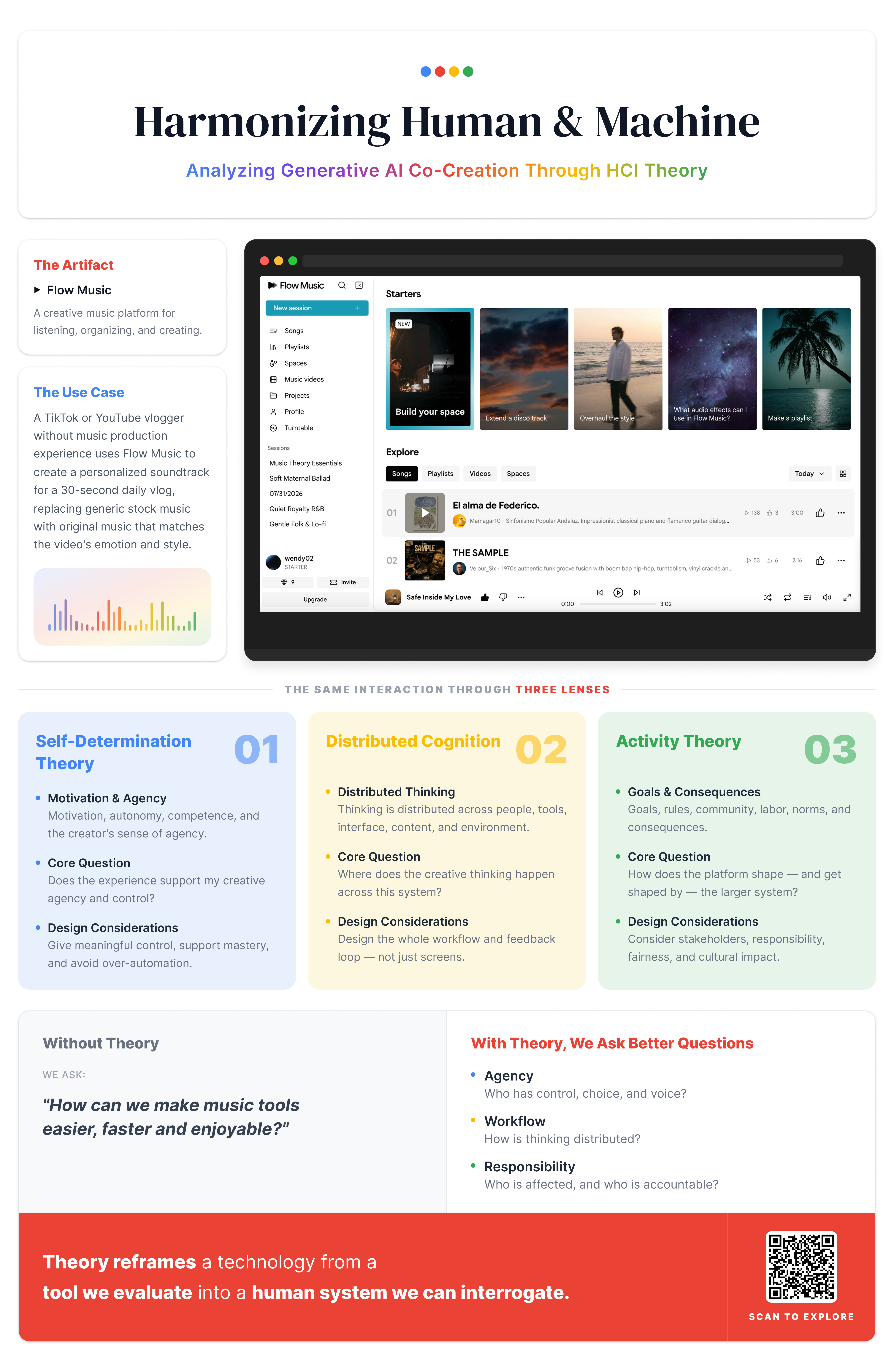
Our analytical poster connects creative agency, distributed thinking, and the wider consequences of AI co-creation.
View full-size poster ↗Video presentation
Explore the HCI theories behind our Flow Music analysis.
Watch video on Google Drive ↗Co-creation lens / reconstructed
An analytical framework for an existing product, not a new music-generation system.
The team examined a vlogger creating a short soundtrack without music-production experience. Self-Determination Theory connected assistance to autonomy and competence: the creator still needs meaningful choices.
Distributed Cognition helped us examine thinking across the person, interface, generated music, and feedback. The focus extended beyond a single prompt or output.
Activity Theory connected creative goals to community norms, roles, and responsibilities. This brought questions of fairness and cultural impact into the product analysis.
A shared framework for discussing creative control and the wider implications of generative music tools.